Trump Doubles Down on $5,000 'Dividend' Checks for Americans if Republicans Keep Congress
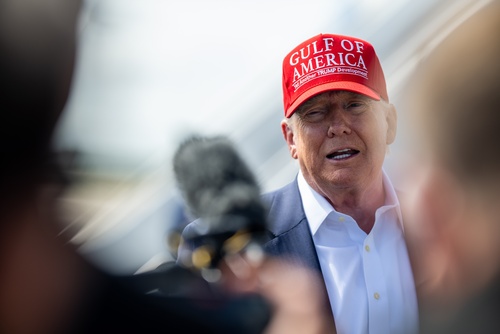
President Trump has promised that if Republicans keep control of the House and Senate after the midterm elections, the government will send a $5,000 dividend check to every adult United States citizen. He first made the pledge last month at the Republican National Committee's (RNC) midterm convention in Dallas, saying the payment was contingent on the GOP winning both chambers and that the money would have to be spent inside the US. He has since repeated the promise multiple times, telling reporters outside Air Force One that it will happen "100 percent" because the country is "taking in trillions and trillions of dollars."
The math is daunting. There are roughly 245.3 million adult US citizens, so a flat $5,000 payment would cost more than $1.2 trillion, far beyond what the government currently collects in tariff revenue, the funding source the administration has pointed to. Commerce Secretary Howard Lutnick has said the checks would not come from taxpayer dollars or add to the deficit, while National Economic Council (NEC) Director Kevin Hassett has suggested the payments could move through a reconciliation package, the budget process Congress uses to pass certain spending and tax bills. Either way, the administration cannot send the money without Congress first appropriating the funds.
The $5,000 promise follows a smaller $2,000 tariff dividend Trump floated last November for low and middle income earners, which the Yale Budget Lab estimated would cost around $450 billion and which Treasury Secretary Scott Bessent said would also require legislation. Sen. Bernie Moreno (R-Ohio) has said he plans to introduce a bill to make the $5,000 dividend official, but other Republicans have been cooler on the idea. One former White House official told The Hill the giveaway promises aren't clearly helping GOP candidates heading into November.
What supporters say:
Backers argue the tariffs have genuinely brought in new revenue, hundreds of billions of dollars, and returning some of it directly to citizens is a straightforward rebate rather than new spending.
Sen. Bernie Moreno has already pledged to write legislation to make the dividend official, giving the idea at least one concrete legislative vehicle in Congress.
Trump and his team frame the payment as proof the economy is strong enough to fund itself, distinguishing it from pandemic-era stimulus that was financed through borrowing.
What critics say:
A flat $5,000 payout to every adult citizen would cost more than $1.2 trillion, several times what the government has collected in tariff revenue to date, leaving a large gap between the promise and the money on hand.
The administration cannot legally send out payments like this without Congress first appropriating the funds, and officials including Kevin Hassett have acknowledged it would need a reconciliation bill, an uncertain path given lukewarm GOP support.
The pledge is explicitly tied to a future election outcome, which critics say turns a government payment into a campaign incentive rather than a policy decided on its own merits.
A similar, smaller $2,000 tariff dividend promised for mid-2026 still hasn't gone out, and the Yale Budget Lab's analysis put even that scaled-down version at roughly $450 billion, raising doubts the bigger number is realistic.
What's your take?
Is Trump's promise of $5,000 dividend checks if Republicans win the midterms legally and financially realistic? Yes  No
 Other

Sources:
The Hill: Trump says $5K dividend checks will 'happen 100 percent'
The Hill: Trump ramps up GOP campaign promises in midterm elections
#TrumpDividend #Midterms2026 #TariffRevenue #FederalBudget #Republicans
Now let's hear from you.
You get one Take and 3 ratings so use them well.
Strong arguments beat loud ones. See Moving The Needle (How to)
Don't forget to rate your own Take.
Please don't feed the trolls.