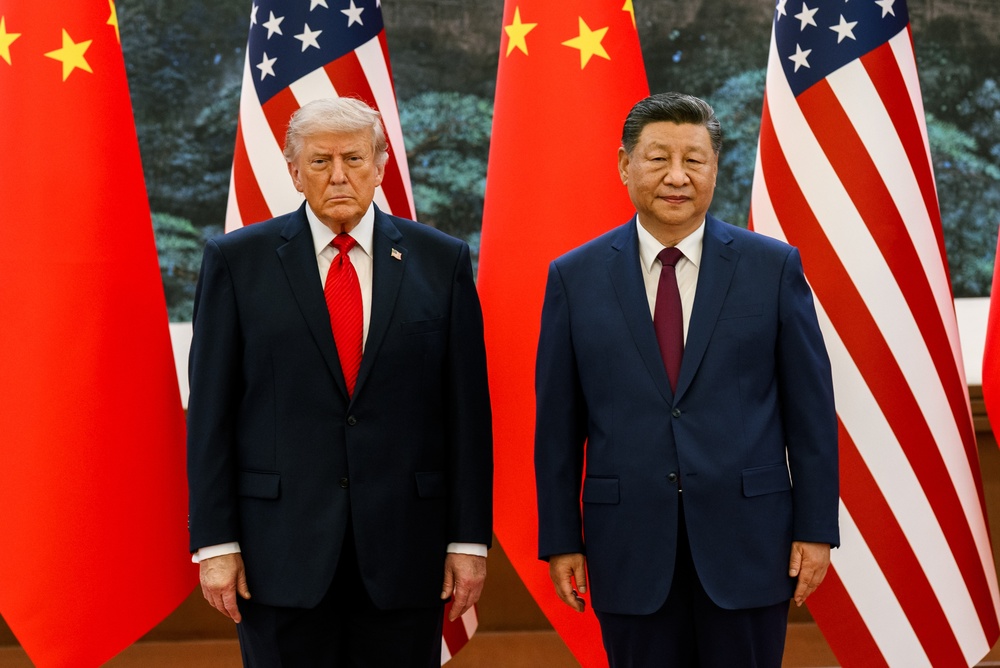
Trump Rolls Out Rare Red-Carpet Welcome for Xi as US and China Extend Tariff Truce to January
Was extending the US-China tariff truce through January the right call for Trump's trade strategy? Chinese President Xi Jinping landed in Washington on Wednesday evening for a three-day state visit, his first trip to the U.S. capital in more than a decade. President Trump broke with recent protocol and personally greeted Xi on the tarmac at Joint Base Andrews, the first time a sitting president has welcomed a foreign leader there in 11 years, since Barack Obama met Pope Francis in 2015. The arrival included a red carpet, an honor guard and a flyover from two B-1 bombers.
Just as Xi's plane touched down, Treasury Secretary Scott Bessent announced that U.S. and Chinese officials had agreed to extend their tariff truce, first struck in Busan, South Korea last October, through January 10 instead of letting it lapse on November 10. The truce lowered tariffs on both sides, paused restrictions on Chinese rare earth mineral exports and kept a Chinese pledge to buy large volumes of American soybeans. Bessent said some of China's commitments, particularly on rare earth deliveries, have not been "fully carried out" and that Washington wants clearer follow-through over the coming months.
The visit continues Thursday with an Oval Office meeting and an expanded Cabinet Room session, followed by a state dinner in the East Room where tech executives including Nvidia's Jensen Huang are expected to attend. Trump and Xi are scheduled to have tea and tour the National Archives on Friday. Unresolved disputes over export controls on rare earths and chips, Taiwan and China's ties to Iran remain on the table even as both sides tout the extension as a step toward calmer relations.
What supporters say:
Extending the truce avoids a renewed tariff shock for consumers and businesses just as the two sides negotiate a more comprehensive deal.
Keeping rare earth exports and soybean purchases flowing protects supply chains and American farmers who depend on Chinese demand.
A calmer diplomatic tone reduces the risk of miscalculation between the world's two largest economies at a volatile moment.
What critics say:
A two-month extension kicks the hardest disputes, rare earths, chip controls and Taiwan, down the road without resolving them.
The red-carpet treatment rewards Xi with symbolic legitimacy while China has only partially followed through on its prior commitments.
Tariff whiplash between escalation and truce leaves companies unable to plan long-term investment or sourcing decisions.
What's your take?
Was extending the US-China tariff truce through January the right call for Trump's trade strategy? Yes  No
No  Other
Other 
Sources:
#USChinaRelations #Tariffs #XiJinping #TradePolicy #Trump
Now let's hear from you.
You get one Take and 3 ratings so use them well.
Strong arguments beat loud ones. See Moving The Needle (How to)
Don't forget to rate your own Take.
Please don't feed the trolls.