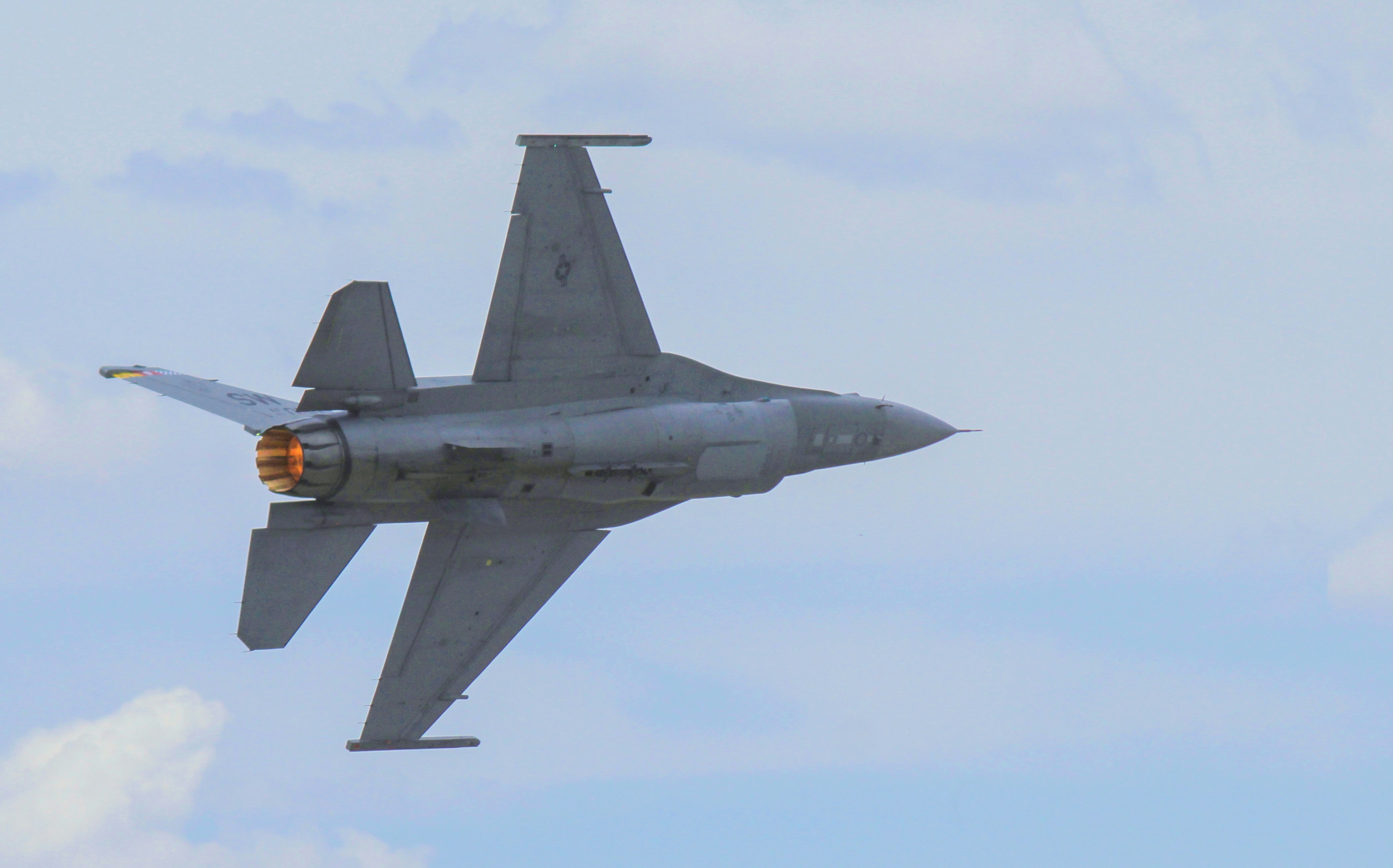
Air Force Puts AI-Controlled F-16 Through Live Flight Tests as Autonomous Combat Nears Reality
DARPA and the U.S. Air Force have begun flying a modified F-16 under the control of an artificial intelligence agent as part of the VENOM program, short for Viper Experimentation and Next-generation Operations Model. A test pilot stays in the cockpit and can switch between human and AI control with the flip of a switch, but for portions of recent flights out of Eglin Air Force Base in Florida, the AI agent has flown the jet itself while the pilot monitors and can retake control at any moment. The autonomous flights began in July 2026 after initial piloted safety checks in June confirmed the aircraft modifications performed as expected.
The VENOM kit connects to the F-16's existing flight controls and mission systems without altering its core software, letting engineers swap different autonomy packages onto the same jet for rapid testing rather than grounding it for lengthy rebuilds between experiments. The work builds on DARPA's earlier Air Combat Evolution program, which in 2023 used a heavily modified F-16 called the X-62A VISTA to fly at least 21 sorties in a live within-visual-range dogfight against a human-piloted jet. Three F-16s were converted into VENOM testbeds in 2024 and 2025 and are now flying with the Air Force's 96th Test Wing.
DARPA has said the program's next phase, called AI Reinforcements, will test multiple AI agents in live flight and eventually feed into the Air Force's Collaborative Combat Aircraft program, which aims to pair crewed fighters with autonomous wingmen. Officials describe the current testing as exploring how AI agents handle the uncertainty, deception and degraded conditions that human pilots train for, calling it one of the final steps before the technology moves toward operational use.
Arguments for:
Air Force officials argue that testing AI agents in real, uncertain flight conditions rather than only in simulators is necessary to prove the software works before it is ever trusted in combat.
The VENOM kit's ability to swap autonomy packages onto the same jet lets engineers compare agent behavior directly against pilot performance without the delays of rebuilding aircraft between tests.
Supporters see the program as a path toward fielding larger numbers of lower-cost Collaborative Combat Aircraft alongside crewed jets, expanding the fleet without waiting years to train additional fighter pilots.
A human remains physically in the cockpit throughout current testing with an override available instantly, which backers say keeps the near-term risk contained while the technology matures.
Arguments against:
Arms-control advocates warn that normalizing AI-controlled combat aircraft testing moves the military closer to autonomous systems making engagement decisions with less human oversight over time.
National security analysts note that rival powers are pursuing similar autonomy programs, raising concern about an arms race in AI-controlled combat aircraft that outpaces any international rules on lethal autonomous weapons.
Skeptics point out that AI agents trained largely in simulation can behave unpredictably once exposed to real-world deception, sensor failures or electronic warfare, precisely the failure modes this test campaign is designed to probe because they remain unsolved.
Critics argue that transitioning this technology toward the Collaborative Combat Aircraft program before those failure modes are fully understood risks locking in doctrine around a capability that isn't yet mature.
What's your take?
Should the Pentagon continue expanding AI-piloted combat aircraft testing like the VENOM program? Yes  No
No  Other
Other 
Sources:
#ArtificialIntelligence #DARPA #MilitaryTech #Autonomy #AirForce
Now let's hear from you.
You get one Take and 3 ratings so use them well.
Strong arguments beat loud ones.
Don't forget to rate your own Take.
Please don't feed the trolls.
Photo credit: chandler-cruttenden on Unsplash